
Not all income is created equal: The declining efficacy of Bonds as Equity diversifiers

Structural changes in markets mean portfolio approaches, and the concept of defensive assets, must evolve to provide dependable income. The historical negative correlation between equities and bonds has become increasingly unreliable in recent years. What once looked like diversification now risks concentration.


This shift has been reinforced with recent geopolitical tensions, such as the Middle East conflict, where traditionally defensive assets have continued to react unexpectedly. In this evolving landscape, investors may need to consider alternative solutions, and contractual income streams provide a stable, reliable, and non-correlated alternative to increase portfolio resilience.


Key points

  • The investment landscape has changed, and long-term structural trends are driving further transformation as economies adapt to new economic regimes.
  • The historical diversification benefits of bonds are breaking down, with increased correlation between equities and bonds (move in same direction).
  • Contractual non-correlated income streams offer a stable and predictable solution, unaffected by market volatility or traditional asset correlations.

Adapting to a changing investment landscape

The early years of the 2020s have reshaped market dynamics through policy disruptions, supply chain shifts, and challenges to social cohesion. The recent progression of technology and AI has only further accelerated this pace of change. Long-standing beliefs about markets and portfolios are being challenged, and in some cases, overturned, making the task of creating resilient portfolios significantly more complex.

Long-term trends are now driving further structural changes to the market through:

·         Rising government debt as policymakers have shown little appetite for bringing public spending down from the highs reached in the COVID era.

·         Shifting demographics as ageing populations are shrinking workforces and exacerbating government debt challenges.

·         Disruption of labour markets as rapid advancements in AI are disrupting traditionally stable sectors of the employment market.

·         Persistent inflationary pressures as lingering supply chain constraints, ongoing deglobalisation and geopolitical uncertainty suggest that inflation, and therefore higher-rates, might be here to stay after an extended period of near zero-interest rates.

In this economic environment traditional patterns are breaking down more quickly and correlations have become less predictable.

The decline of bonds as a reliable diversifier

For many decades, diversification strategies primarily focused on two asset classes: equities and bonds (60/40 portfolio). While the use of these assets has evolved over time, their role has formed a consistent foundation of portfolio diversification for many decades. However, for this strategy to work effectively, two critical factors must hold true:

1.      A low correlation between equities and bonds.

2.      Low volatility for bonds, given their role as a source of stability.

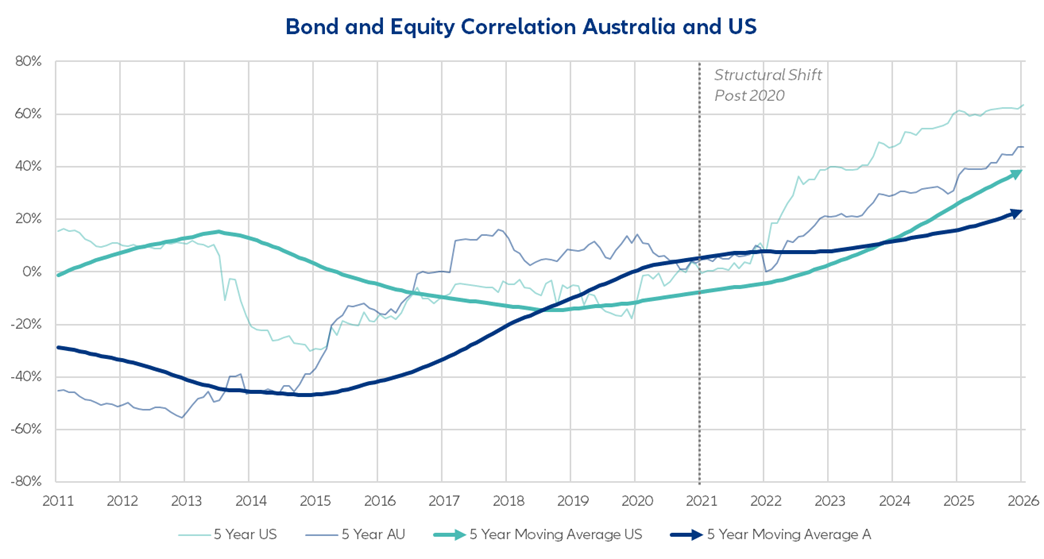
In recent years, these two pillars have eroded. The historical negative correlation between equities and bonds has weakened, and bond market volatility has increased. This shift has left investors grappling with how to build resilient portfolios in an environment where traditional defensive assets no longer behave as expected.
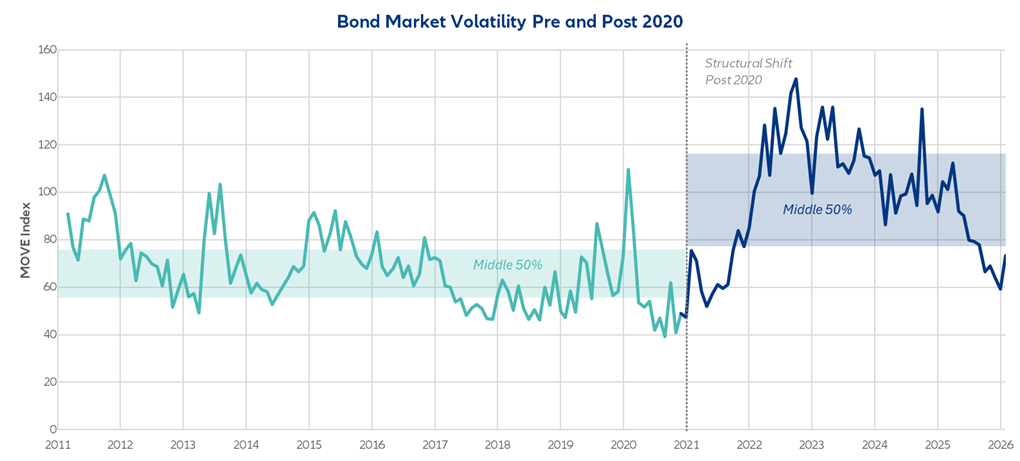
ICE BofA US Bond Market Option Volatility Estimate (MOVE) Index reflecting the level of volatility across US Treasuries. Source: Bloomberg March 2026.
5 year trailing correlation of monthly returns of equity and bond indices Jan 2010 to February 2026. US - Bloomberg US Aggregate Index and S&P 500 Index. AU - Bloomberg AusBond Composite Index and ASX 200. Source Bloomberg March 2026.

What’s going on?

Recent market behaviour in responses to disruptive events underscore this shift. Market participants have had to contend with simultaneous selloffs in bonds, equities, and even gold recently, highlighting the fragility of traditional diversification strategies in risk-off events. This breakdown in correlations has sent shockwaves through global portfolios, forcing investors to rethink their approach to risk management.

However, there exists an alternative source of income that stands apart: contractual non-correlated income streams. These income solutions are not tied to the traditional market dynamics of equities and bonds, offering a level of stability and predictability that is increasingly rare in today’s investment landscape.

What is a contractual non-correlated income stream?

A contractual non-correlated income stream provides guaranteed income that is unaffected by market volatility or traditional asset correlations. It is a solution designed to deliver consistent cash flow, regardless of market conditions. These income streams provide a safe alternative to traditional asset classes with:

·         Guaranteed income at relatively higher rates with payments that are set now and backed by an insurance company rather than being subject to market volatility.

·         A reliable and predictable income source that gives retirees confidence in knowing their cashflow is secure and consistent, functioning more like a regular pay cheque.

·         Long-term security backed by financial strength with investors placing their trust in a registered life insurance company with strong regulatory oversight to ensure their stability.

These income streams can provide a critical layer of stability in a portfolio, particularly in times of heightened uncertainty.

Building resilience in a new era

As market signals continue to demonstrate an increasing correlation between equities and bonds, it’s clear that traditional diversification strategies are no longer as effective as they once were. In this environment, building a truly diversified portfolio requires new thinking.

Contractual non-correlated income streams offer a compelling solution, providing stability and predictability in an unpredictable world. For investors seeking to navigate this new era of market dynamics, exploring these innovative income solutions could be the key to long-term portfolio resilience.


Martin Wilkinson

Head of Investments

martin.e.wilkinson@allianz.com.au

Adam Downy

Investment Analyst

adam.j.downy@allianz.com.au


Allianz Retire+ is a registered business name of Allianz Australia Life Insurance Limited ABN 27 076 033 782, AFSL 296559. This information contains opinions that are current as at 9 March 2026 unless otherwise specified and is for general information purposes only and is not comprehensive or intended to give financial product advice. Any advice provided in this material does not take into account your objectives, financial situation or needs. No person should rely on the content of this material or act on the basis of anything stated in this material. Allianz Retire+ and its related entities, agents or employees do not accept any liability for any loss arising whether directly or indirectly from any use of this material.

Any information on this website does not take into account your objectives, financial situation or needs. For personal financial advice please speak to your financial adviser. Products will be issued by Allianz Australia Life Insurance Limited, ABN 27 076 033 782, AFSL 296559.

Allianz Retire+ is the business name of Allianz Australia Life Insurance Limited. By using this website you agree to access this Financial Services Guide.